Wednesday, 11 February 2015

Sapporo Snow Festival, Japan.


Hello everyone!

Escultura del patinador Yuzuru Hanyu
Today we bring you a post about the Snow Festival in Sapporo, Japan

This festival is held annually and during the first week of February in Sapporo, Japan, and is held in Odori Park, Susukino and in Sapporo Satoland.

This show is considered one of the most important events in the japanese winter
and this year was held between the 5th and 11th of this month. In it, millions of people admire the hundreds of buildings, statues and ice sculptures of snow, as well as they can practice and do snow sports and acitivities such as snowboarding; buy souvenirs and food in lots of stands; and also listen to music in live concerts.

In fact, since 1974, the International Ice Sculpture Contest at Odori Park has been celebrated, where different teams from around the world can participate. Every year around 400 sculptures are made, and the TV Tower of Odori Park is the best place to admire this spectacle.

Illuminated Sculptures.

We hope you liked this post about this festival held these days in Sapporo. We also want to leave you a video about this year's festival recorded by Mira, a Canadian girl living in Japan, who has a youtube channel, "kanadajin3", where she shows us what is Japan life like. 


See you!


Source: Wikipedia

Photo: Kazuhiro Nogi/AFP/Getty Images
           japanesesearch.com

Video: Youtube


Monday, 9 February 2015

The Adirondacks.

Hello everyone!

Today we bring you this post on one of the largest parks in the US, the Adirondacks.

Autumn in the Adirondacks.
Adirondack State Park is the largest park in the continental United States with 2,428, 114 hectares of mountains, forests, hills, valleys and lakes,  and is larger than Yosemite or the entire state of Massachusetts.

Inside are some of the highest mountain peaks in the State of New York, such as Mount Marcy with 1629 meters high. These mountains, which are the ones that give the park its name, are among the oldest in the world, and are made up of rocks of millions of years, specifically from the Precambrian era. Ebenezer Emmons, a geologist from the 1830s, gave the mountains the name of a tribe of Indians who hunted in the area.

In 1882, the Legislature of the State of New York declared this region National Park although there were private properties which still remain. The aim was to legally protect wildlife in the region and avoid land being sold, rented or exchanged, nor occupied by private or state corporations.

The Adirondacks.
Among the fauna inhabiting this region, we find mammals such as opossums, moles, beavers, squirrels, bears, raccoons, moose; reptiles and amphibians such as snakes, frogs and turtles; birds such as eagles, owls and other smaller birds; and all kinds of insects. Regarding the flora, this region is home to all kinds of trees, such as beech, pine, birch, maple, fir or elm, having some of these species leaves of other colors to standard, so in fall season, we can see a blanket of colors like red, yellow, brown or green.

Thus, besides the wildlife and forest landscapes, towns and villages, lakes and streams, we can also find a large and wide commercial and tourist attractions, museums, restaurants, hotels and craft shops.

We hope you liked this post.

See you!


Source: wikipedia
             usa.travelguia.net
             discoveramerica.mx
             esf.edu
             visitadirondacks.com

Sunday, 1 February 2015

The Stilt Fishermen.

Good evening everyone!

Fishermen in the area of Galle in Sri Lanka are known as stilt fishermen . They are so called because they fish perched on stilts stuck about 3 feet into the sea and about 20 meters from the beach. But how can they fish perched on stilts? Thanks to a stand called "Petta"  placed transversely to the vertical post, fishermen can sit. To avoid falling into the water, these fishermen hold on to the stilt with one hand while using the other one to fish.


Fishermen fishing perched on stilts.

Everyday at dawn and dusk, fishermen get on stilts for hours, as this is when the fish are most active. They place the fish in plastic bags tied to the post or their waist.

Stilt fishermen do not use nets, since from above the stilts, they go unnoticed for fish, so they do not discover their position and the fish do not notice their presence. Another reason is that the use of nets can make the fish disappear for a long time, forcing fishermen to go deeper into the sea.

It is believed that this tradition began after World War II, when fishermen began using the remains of the iron bars that remained after the conflict, but later they began to use wooden sticks as they found that they could also hold their weight.

We hope you enjoyed this tradition.

See  you!


Photo:   arenatours.com
Source: ocholeguas.com

The Monumental Fountains of La Granja de San Ildefonso.

Good evening everyone!

We say goodbye for today with a post about the Monumental Fountains of the Royal Palace in La Granja de San Ildefonso. 

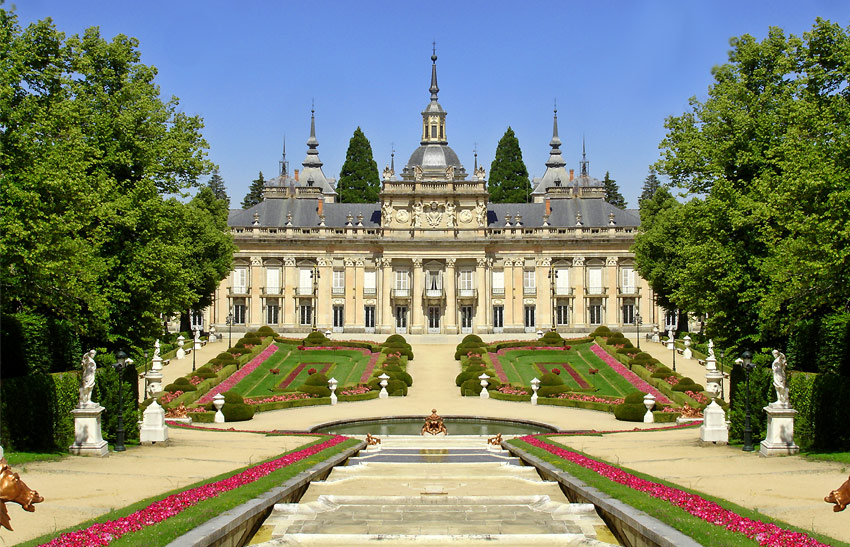
Royal Palace of La Granja de San Ildefonso

The Royal Palace of La Granja de San Ildefonso is one of the residences of the Spanish royal family in Segovian municipality of San Ildefonso and was named National Heritage or Patrimony. This is open to the public and consists of a palace and outbuildings, and large gardens where we can find the Monumental Fountains, the protagonists of this post.

Spread around the grounds of the resort are 21 fonts inspired by classical mythology, which include deities, allegories and mythological scenes. Originally they were built in plumbum to prevent corrosion, but later, they were painted to give the appearance of brass and give them a nobler aspect, as in Versailles.

Fountain of Diana's baths.

All these fountains have over 300 jets in total and can consume an average of 9,000 cubic meters of water per hour if they ran at the same time. If we make the relevant calculations, this amount of water would be ... as the entire amount of water consumed in Segovia!. So, to avoid this huge waste of water, which would dry the main tank in half a day, and also to avoid deterioration caused by continuous operation, they have never been activated simultaneously. Because of this, the fountains have their own opening hours if we want see them operating. The problem is that depending on the day we go, we can see different fountains activated, but not all.

To see all fountains activated, we must visit the gardens in one of the three following days:

The day of San Fernando, May 30.
The day of Santiago, July 25.
The day of San Luis, August 25.

In these three days, the gardens are full of excited people following the route of the fountains, which are activated at a time, so you have to be quick, because as a fountain is deactivated, the next one begins functioning, and you should know that not all fountains are one beside the other.

Here you have a list of some of the fountains that you can find in the gardens and a refreshing video about these fountains activated:


    The fountain of the frogs.
  • Fountain of the Horse Race.
  • Fountain of the New Waterfall. 
  • Fountain of Fame.
  • Fountain of Winds.
  • Fountain of the Jungle.
  • Fountain of the Shells.
  • Fountain of the fan and the zephyrs.
  • Fountain of upper and lower cups.
  • Fountain of the upper and lower Dragons.
  • Fountain of Andromeda.
  • Fountain of half moon Dragons.
  • Fountain of the old waterfall and the estuary.
  • Fountain of Diana's Baths.
  • Fountain of the Frogs.
  • Fountain of the small bascket.
  • Fountain of the Eight Streets.


See you!


    Source: Wikipedia
                guias-viajar.com
                panoramagriego.gr
                pueblos-espana.org
    Video:  Youtube

    Antarctica, the pulsating continent.

    What is the continent that resizes?

    Hello everyone!

    If you're thinking of Antarctica, you're right. Because of the ice sheets of Antarctica that change in size during the year, this is also known as the Pulsating Continent. But, why? If we use logic, the answer is simple. If during the summer temperatures rise, it is expected that much of the ice sheets melts, and when this happens, Antarctica reduces its surface to 14 million square kilometers or so. However, the opposite occurs during the winter, when the size of the area reaches 30 square kilometers, since the blocks of ice lost during the summer are replaced and even increase.

                   September (Winter in the south hemisphere)                                       February (Summer in the south hemisphere)

    We hope you enjoyed this curiosity about the frozen continent.


    See you!


    Source: Wikipedia
    Photo:   abcienciade.wordpress.com

    The Avenue or Alley of the Baobabs.

    Hello travelers!

    Here you have a fairy tale place, the Avenue of the Baobabs in Madagascar.

    The Avenue of the Baobabs is a group of baobab trees found on both sides of the road between Morondava and Tsiribihina Belon'i in Menabe region in the western part of Madagascar. It is one of the attractions that the country has available for travelers around the world, as these trees form an unusual landscape proper of a fairy tale. In fact, it would not be surprising that in the future these trees will become the country's National Monument.


    Avenue of the Baobabs, Menabe, Madagascar.
    Along the avenue, in a segment of about 260 meters long, about 25 baobab trees of 30 meters high remain standing. In other places nearby, another 25 more trees are erected.

    For those who are not familiar with this type of trees,  African baobabs or andasonia are enormous massive-trunk trees that can have bottle shape, irregular shape and are lumpy. They can grow between 5 and 30 meters, and the diameter of its trunk is over 11 meters. Its bark is smooth touch and leaves sprout only during the rainy season and its flowers of white petalsare about 10 cm big . Regarding the longevity of these trees is amazing what they can live. If the right conditions are given, such as good soil and good climate, baobabs can live up to 800 or 1000 years, although some are said to have lived up to 4000 years.

    Coming back to what we were saying about the Avenue, the baobabs of this place are the legacy of tropical forests that once populated Madagascar. That trees are isolated in the place they are standing it is no coincidence since long before, it was a forest. What happened is that throughout the years and due to population growth, forests were felled to make way for agriculture, only leaving the Baobabs trees standing, to which the villagers have enough respect.


    Baobabs Amoureux
    Besides the Avenue, there is another place about 7 km away where you can find two baobab trees intertwined. These two trees are known as Baobab Amoureux (Baobabs Lovers or Baobabs in love) and are the protagonists of a legend. According to this, these two baobabs were born and grew together through the centuries. The baobabs arose because of an impossible love between a boy and a girl from a nearby village. However, both the boy and the girl already had an assigned partner and had to marry separately in separate villages. The couple had dreamed of having children and an eternal life together, so secretly aske their God for help. Both baobabs were born then and now live together for eternity as the young lovers once desired.

    We hope you enjoyed it.

    See you!


    Source: Wikipedia
                 Wikipedia
    Photos: taringa.net
                 voyage.guide-mg.com

    The Jaracanda City.

    Good afternoon everyone! 

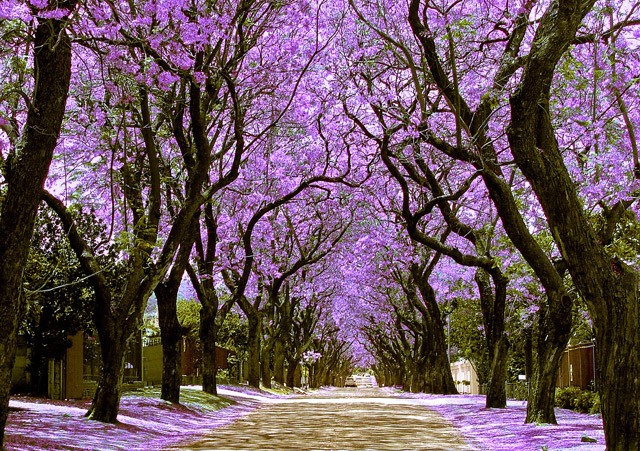
    Jaracanda trees adorning a street in Pretoria.
    This afternoon we bring you a South African floral spectacle that we would have never thought could be there. The truth is that we have been quite surprised when we were looking for a country to speak in this post and we've found this. So here you have an entry about the Jaracanda City, Pretoria.

    Located in the province of Gauteng, 50 km from Johannesburg, Pretoria is the administrative capital of South Africa, as well as a modern and cosmopolitan city. It is a city for universitarians and is full of attractions including Church Square, which is surrounded by old buildings such as the Palace of Justice, the Office and the Municipality; the Union Buildings, seat of government with beautiful gardens; various museums (the Science and Technology Museum, Arts Museum, and the Cultural Museum of History) and Fountains Valley, a park with flowers and native birds 5 kilometers from the city. In addition the city is a safe place that can be traveled by public transport, taxi or on foot.

    Although the city has all this and more, what characterizes this city, are the trees that adorn its streets. Pretoria is known as the Jaracanda City, since from late September to mid-November, about 70,000 Jaracanda trees bloom covering the city with a purple robe.

    Pretoria, Sout Africa
    For a good view of this purple sea, it is best to  go towards Klapperkop where we can see from bird's eye view a beautiful landscape. Although the whole city is covered in purple, from Klapperkop you can also see a hundred white Jaracanda trees adorning Herbert Baker Street in Groenkloof.

    Praetorians love the Jaracanda trees and are so proud of them that even some beliefs about these trees exist. For example, students at the University of Pretoria believe that if during exams, a flower falls on your head, it's a sign of good luck, and it means you will pass your exams successfully.

    Undoubtedly, it is a view worth seeing, and we could say that Jaracanda trees are in Pretoria what Cherry trees are Japan.

    With this purple explosion we say good bye.


    See you!


    Source: Wikipedia
                  showme.co.za
    Photos:  news-events.sleeping-out.co.za
                  south-africa.me.uk