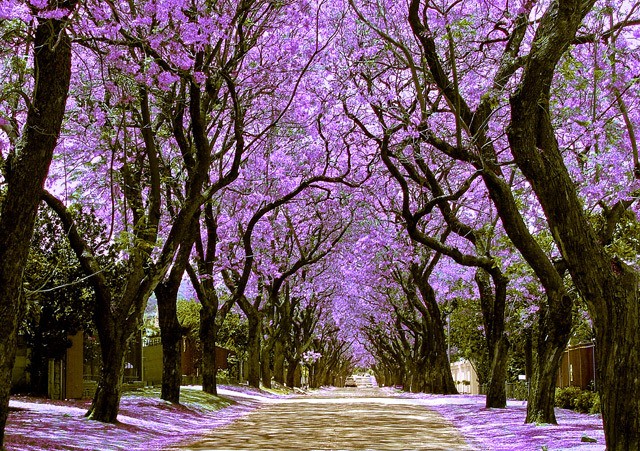
Hello travelers!
Here you have a fairy tale place, the Avenue of the Baobabs in Madagascar.
The Avenue of the Baobabs is a group of baobab trees found on both sides of the road between Morondava and Tsiribihina Belon'i in Menabe region in the western part of Madagascar. It is one of the attractions that the country has available for travelers around the world, as these trees form an unusual landscape proper of a fairy tale. In fact, it would not be surprising that in the future these trees will become the country's National Monument.
Along the avenue, in a segment of about 260 meters long, about 25 baobab trees of 30 meters high remain standing. In other places nearby, another 25 more trees are erected.
For those who are not familiar with this type of trees, African baobabs or andasonia are enormous massive-trunk trees that can have bottle shape, irregular shape and are lumpy. They can grow between 5 and 30 meters, and the diameter of its trunk is over 11 meters. Its bark is smooth touch and leaves sprout only during the rainy season and its flowers of white petalsare about 10 cm big . Regarding the longevity of these trees is amazing what they can live. If the right conditions are given, such as good soil and good climate, baobabs can live up to 800 or 1000 years, although some are said to have lived up to 4000 years.
Coming back to what we were saying about the Avenue, the baobabs of this place are the legacy of tropical forests that once populated Madagascar. That trees are isolated in the place they are standing it is no coincidence since long before, it was a forest. What happened is that throughout the years and due to population growth, forests were felled to make way for agriculture, only leaving the Baobabs trees standing, to which the villagers have enough respect.
Besides the Avenue, there is another place about 7 km away where you can find two baobab trees intertwined. These two trees are known as Baobab Amoureux (Baobabs Lovers or Baobabs in love) and are the protagonists of a legend. According to this, these two baobabs were born and grew together through the centuries. The baobabs arose because of an impossible love between a boy and a girl from a nearby village. However, both the boy and the girl already had an assigned partner and had to marry separately in separate villages. The couple had dreamed of having children and an eternal life together, so secretly aske their God for help. Both baobabs were born then and now live together for eternity as the young lovers once desired.
We hope you enjoyed it.
See you!
Source: Wikipedia
Wikipedia
Photos: taringa.net
voyage.guide-mg.com
Here you have a fairy tale place, the Avenue of the Baobabs in Madagascar.
The Avenue of the Baobabs is a group of baobab trees found on both sides of the road between Morondava and Tsiribihina Belon'i in Menabe region in the western part of Madagascar. It is one of the attractions that the country has available for travelers around the world, as these trees form an unusual landscape proper of a fairy tale. In fact, it would not be surprising that in the future these trees will become the country's National Monument.
 |
| Avenue of the Baobabs, Menabe, Madagascar. |
For those who are not familiar with this type of trees, African baobabs or andasonia are enormous massive-trunk trees that can have bottle shape, irregular shape and are lumpy. They can grow between 5 and 30 meters, and the diameter of its trunk is over 11 meters. Its bark is smooth touch and leaves sprout only during the rainy season and its flowers of white petalsare about 10 cm big . Regarding the longevity of these trees is amazing what they can live. If the right conditions are given, such as good soil and good climate, baobabs can live up to 800 or 1000 years, although some are said to have lived up to 4000 years.
Coming back to what we were saying about the Avenue, the baobabs of this place are the legacy of tropical forests that once populated Madagascar. That trees are isolated in the place they are standing it is no coincidence since long before, it was a forest. What happened is that throughout the years and due to population growth, forests were felled to make way for agriculture, only leaving the Baobabs trees standing, to which the villagers have enough respect.
 |
| Baobabs Amoureux |
We hope you enjoyed it.
See you!
Source: Wikipedia
Wikipedia
Photos: taringa.net
voyage.guide-mg.com