Good morning everyone!,
Today we begin with some data on the magnificent Peking Opera.
Being considered one of the highest expressions of Chinese culture, Beijing Opera (Chinese: 京剧 Jingju or 京戏 Jingxi), is a type of Chinese opera that began in the mid-nineteenth century and became enormously popular among the court of the Qing dynasty.
It has its origins in the provinces of Hubei and Anhui although it is known by the name of Peking Opera and the dialects of these two regions are the ones used in the dialogues of performances.
Regarding to whom it was addressed, Peking Opera is believed to have emerged around the year 1790, when a theater group made a performance to celebrate the 80th birthday of Emperor Qianlong. This may have been the reason why Opera performances were only seen by the imperial court and did not become a public spectacle until later.
Regarding the argument, these are varied and range from stories of war and typical intrigues in courts, to loving, fantastic and mythological stories.
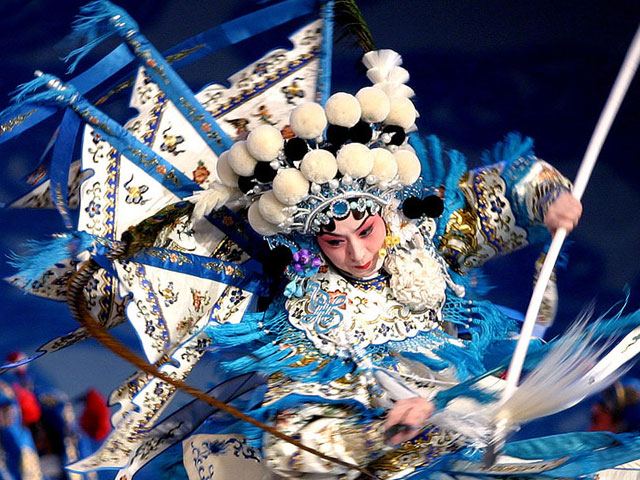
In the development of representations, which can last six hours, both music and songs are so important as gestures, acrobatics and even colorful makeup and costumes, which are one of the most characteristic features of this Opera. In fact, the colour of the costumes used by the actors represent different types of character. Thus, black represents a bold character; white serves to represent a lying one; blue indicates that this is a cold and calculating character; and red is used for brave and loyal characters. The gold and silver colors, however, are used to represent gods.
Fuente:Wikipedia
Fotos: viajesdechina.com
quyi.chinesecio.com
www.xian-tours.cn
www.meiguoxing.com
Today we begin with some data on the magnificent Peking Opera.
Being considered one of the highest expressions of Chinese culture, Beijing Opera (Chinese: 京剧 Jingju or 京戏 Jingxi), is a type of Chinese opera that began in the mid-nineteenth century and became enormously popular among the court of the Qing dynasty.
 |
| Female character: Tan |
 |
| Male character: Sheng |
Regarding the argument, these are varied and range from stories of war and typical intrigues in courts, to loving, fantastic and mythological stories.
 |
| Male character: Jing |
During the performances, and depending on the subject or argument of these, you can see on stage different types of characters. In Peking Opera we find four different characters, three male characters and one female. Here you will find a brief description of each:
Jing: Male character that has a strong will. It is easily recognized because it always wears an excessive makeup.
Sheng: Male character having three different variants; Warrior Sheng, Young Sheng and Older Sheng.
Ch'ou: Male character. It is the jester.
 |
| Male character: Ch'ou |
Tan: Female Character. This character also has different variants: Older Tan, FlowerTan (a cheerful, young and somewhat sassy woman), Green Tan (young and very righteous woman) and Horse and Sword Tan (a woman who dominates calligraphy as well as the art of War).
Finally, it is important to remember that being one of the most important traditions of China, in Nov. 16, 2010, the UNESCO declared the Peking Opera as Intangible Cultural Heritage of Humanity.
See you!
Fuente:Wikipedia
Fotos: viajesdechina.com
quyi.chinesecio.com
www.xian-tours.cn
www.meiguoxing.com

No comments:
Post a Comment