Showing posts with label Asia. Show all posts

Wednesday, 11 February 2015

Sapporo Snow Festival, Japan.


Hello everyone!

Escultura del patinador Yuzuru Hanyu
Today we bring you a post about the Snow Festival in Sapporo, Japan. 

This festival is held annually and during the first week of February in Sapporo, Japan, and is held in Odori Park, Susukino and in Sapporo Satoland.

This show is considered one of the most important events in the japanese winter
and this year was held between the 5th and 11th of this month. In it, millions of people admire the hundreds of buildings, statues and ice sculptures of snow, as well as they can practice and do snow sports and acitivities such as snowboarding; buy souvenirs and food in lots of stands; and also listen to music in live concerts.

In fact, since 1974, the International Ice Sculpture Contest at Odori Park has been celebrated, where different teams from around the world can participate. Every year around 400 sculptures are made, and the TV Tower of Odori Park is the best place to admire this spectacle.

Illuminated Sculptures.

We hope you liked this post about this festival held these days in Sapporo. We also want to leave you a video about this year's festival recorded by Mira, a Canadian girl living in Japan, who has a youtube channel, "kanadajin3", where she shows us what is Japan life like. 


See you!


Source: Wikipedia

Photo: Kazuhiro Nogi/AFP/Getty Images
           japanesesearch.com

Video: Youtube


Sunday, 1 February 2015

The Stilt Fishermen.

Good evening everyone!

Fishermen in the area of Galle in Sri Lanka are known as stilt fishermen . They are so called because they fish perched on stilts stuck about 3 feet into the sea and about 20 meters from the beach. But how can they fish perched on stilts? Thanks to a stand called "Petta"  placed transversely to the vertical post, fishermen can sit. To avoid falling into the water, these fishermen hold on to the stilt with one hand while using the other one to fish.


Fishermen fishing perched on stilts.

Everyday at dawn and dusk, fishermen get on stilts for hours, as this is when the fish are most active. They place the fish in plastic bags tied to the post or their waist.

Stilt fishermen do not use nets, since from above the stilts, they go unnoticed for fish, so they do not discover their position and the fish do not notice their presence. Another reason is that the use of nets can make the fish disappear for a long time, forcing fishermen to go deeper into the sea.

It is believed that this tradition began after World War II, when fishermen began using the remains of the iron bars that remained after the conflict, but later they began to use wooden sticks as they found that they could also hold their weight.

We hope you enjoyed this tradition.

See  you!


Photo:   arenatours.com
Source: ocholeguas.com

Beijing Opera.

Good morning everyone!,

Today we begin with some data on the magnificent Peking Opera.
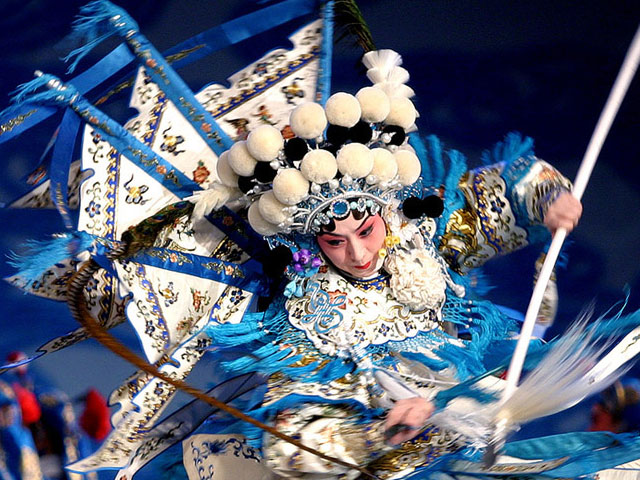
Being considered one of the highest expressions of Chinese culture, Beijing Opera (Chinese: 京剧 Jingju or 京戏 Jingxi), is a type of Chinese opera that began in the mid-nineteenth century and became enormously popular among the court of the Qing dynasty.

Female character: Tan
It has its origins in the provinces of Hubei and Anhui although it is known by the name of Peking Opera and the dialects of these two regions are the ones used in the dialogues of performances.

Male character: Sheng
Regarding to whom it was addressed, Peking Opera is believed to have emerged around the year 1790, when a theater group made a performance to celebrate the 80th birthday of Emperor Qianlong. This may have been the reason why Opera performances were only seen by the imperial court and did not become a public spectacle until later.

Regarding the argument, these are varied and range from stories of war and typical intrigues in courts, to loving, fantastic and mythological stories.
Male character: Jing
In the development of representations, which can last six hours, both music and songs are so important as gestures, acrobatics and even colorful makeup and costumes, which are one of the most characteristic features of this Opera. In fact, the colour of the costumes used by the actors represent different types of character. Thus, black represents a bold character; white serves to represent a lying one; blue indicates that this is a cold and calculating character; and red is used for brave and loyal characters. The gold and silver colors, however, are used to represent gods.

During the performances, and depending on the subject or argument of these, you can see on stage different types of characters. In Peking Opera we find four different characters, three male characters and one female. Here you will find a brief description of each:

Jing: Male character that has a strong will. It is easily recognized because it always wears an excessive makeup.

Sheng: Male character having three different variants; Warrior Sheng, Young Sheng and Older Sheng.

Ch'ou: Male character. It is the jester.

Male character: Ch'ou
Tan: Female Character. This character also has different variants: Older Tan, FlowerTan (a cheerful, young and somewhat sassy woman), Green Tan (young and very righteous woman) and Horse and Sword Tan (a woman who dominates calligraphy as well as the art of War).

Finally, it is important to remember that being one of the most important traditions of China, in Nov. 16, 2010, the UNESCO declared the Peking Opera as Intangible Cultural Heritage of Humanity.

See you!


Fuente:Wikipedia
Fotos: viajesdechina.com
           quyi.chinesecio.com
           www.xian-tours.cn
           www.meiguoxing.com

Thursday, 29 January 2015

What's the Diamond Fuji?

Good morning Everyone!


As the first post of the day, we bring you a beautiful japanese phenomenon, the Diamond Fuji. Butos traemos un precioso fenómeno japonés, el Diamond Fuji. But...What is it? When and where can we see it?. Keep reading and you'll find out...

What is it?


The ダイヤモンド富士(daiyamondo-fuji, in Japanese) or Diamond Fuji, 
is the moment when the of the top of Mount Fuji, either in sunrise or sunset is silhouetted by the sun. It's given this name because at that moment the mountain peak shines like a diamond.

Diamond Fuji, Japan.
What is the best moment to see it?

To enjoy this beautiful spectacle, the best time of year is winter, in particular, from the second half of October to the end of February.

Where can we see this phenomenon?

Regarding the place, one of the best places from which we can see it, film it or shoot it, is from Lake Yamanaka (山 中 湖 Yamanaka-ko) in the town of Yamananako, in Yamanashi Prefecture. However, if you cannot get there, you can also see it in the distance from the highest buildings of Tokyo.

So, lovers of photography near the place, do not let this opportunity pass.

We also want to leave this nice video of the sunrise on the summit of Mount Fuji.


See you!


Source: Wikipedia

Photo:   Google Imágenes
Video:   Youtube